


If you have a spare quarter of an hour in the living room, you have a full workout. The routine waiting for you here is a structured full-body session of about 13 minutes on the Pilatix machine, built to strengthen the core, improve range of motion and teach the body to work with control and precision. No prior experience is needed, only a willingness to move slowly and breathe deeply.
This article is for general information only and does not replace personal advice from a doctor or qualified professional. If you are dealing with an injury, ongoing pain, pregnancy or another medical condition, it is best to check before starting a new training programme.
Is a compact reformer really effective?
A fair question. A folding home reformer looks modest next to the huge studio machines, but the principle doing the work is exactly the same: spring resistance. Unlike a dumbbell, which loads the muscle only when you lift it against gravity, a spring keeps continuous tension through the whole movement, on the push and on the way back. The muscle never gets a moment off, so every second of the exercise counts.
The resistance range runs roughly from 10 to 30 pounds (about 4.5 to 13.5 kg), which is exactly the space a beginner needs: light enough to learn clean movement, challenging enough that the muscles know they worked. Studies published in scientific journals in the field examined work against reformer spring resistance and found strong activation of the deep core muscles alongside improvements in strength and posture, all at a relatively low load on the joints.
That last point deserves another second of attention. The carriage glides, it does not bounce. There are no landings and no impact through the knees or lower back, so you can train seriously even if running and jumping do not agree with your body.
Which muscles does the workout use?
The short answer: almost all of them, just not the way a regular gym does it. The secret is the moving carriage. When your support surface is constantly shifting, the body has to stabilise itself at every moment. So alongside the muscles performing the movement itself, the quiet stabilisers work in the background, the ones responsible for upright posture and for that sense of control in the body.
The core muscles — the deep abdominals, the obliques and the lower back stay engaged throughout the routine, because without them the carriage simply runs away.
Glutes and hamstrings — the various bridge exercises wake up precisely the muscles that fall asleep during long hours of sitting.
Shoulder girdle and upper back — pulls and rows against the springs strengthen the muscles that draw the shoulders back and open the chest.
The deep stabilisers — small muscles around the spine, the pelvis and the shoulder blades, which are very hard to reach with ordinary exercises on a stable floor.
Because the load is shared between so many muscle groups at once, one short routine is enough to touch the whole body. That is exactly why a 13-minute workout can feel like a great deal more.
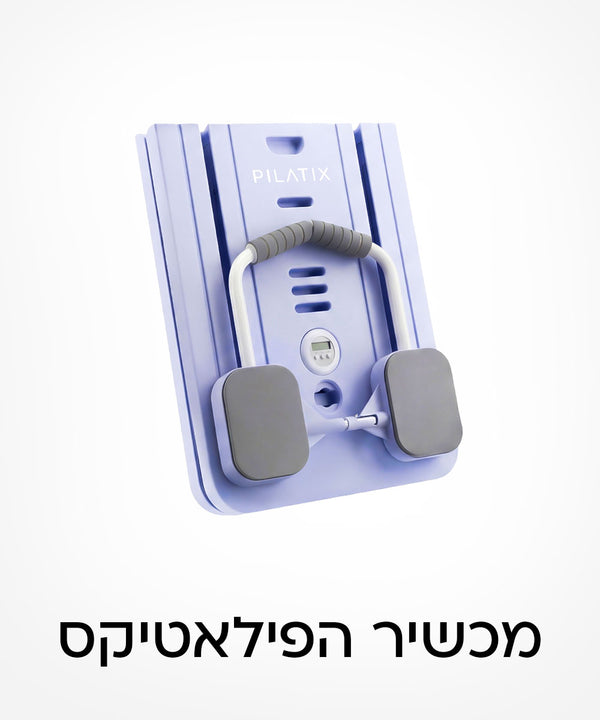
The Pilatix machine comes with an app of 70+ guided workouts and free delivery nationwide — your living room becomes a studio.
See the machine ←The full programme — a full-body routine of about 13 minutes
Here is the routine, exercise by exercise. Work through it in order, without long pauses in the middle, and the whole thing closes at around 13 minutes including the finishing stretches. Keep a light spring for the first few times, and let the body learn the path before you add resistance.
ExerciseDurationMuscles involvedWarm-up stretches15 secondsGeneral preparationKneeling knee extension (right)20 secondsQuadriceps, hip flexorsKneeling knee extension (left)20 secondsQuadriceps, hip flexorsBridge with extended leg30 secondsGlutes, hamstrings, coreMountain climbers on the carriage30 secondsCore, shouldersAlternating bridge30 secondsGlutes, hamstrings, lower backAlternating arm reach with the straps30 secondsShoulders, chest, mobilityLateral arm pull (left)30 secondsLats, upper backShoulder raise (left)30 secondsDeltoids, shoulder stabilityLateral arm pull (right)30 secondsLats, upper backShoulder raise (right)30 secondsDeltoids, shoulder stabilityUpright row20 secondsTraps, deltoids, upper backSeated elbow curl30 secondsBiceps, forearmsFinishing stretchesabout 3 minutesGeneral recovery
How does this actually flow? The first rule is precision before speed. Six slow, full repetitions beat twelve rushed ones. Pilates hands out no prizes for pace, it hands them out for control, and you feel the difference in your body by the second or third session.
Your breath is the metronome. Exhale at the moment of effort, as you push or pull against the spring, and inhale on the way back. When the breath leads the movement, the rhythm sorts itself out and your head stays inside the workout instead of drifting to the to-do list.
And the part that is easiest to miss: the way back. Do not let the springs pull the carriage in all at once. Slow it deliberately, resist it every centimetre, because half the work of this session happens in exactly that phase. Move between exercises briskly but calmly, to keep the warmth you have built in the muscles.
Why is it beginner friendly?
There is a mistaken idea that springs exist only to make things harder. The truth is the opposite: in most exercises the spring actually supports you. It defines a clear path of movement, guides the body the right way and gives immediate feedback when something drifts off line. For someone just starting, that is almost a guiding hand.
Another advantage is how quickly it adapts. Feel the exercise is too heavy? Release spring tension. Too light? Add some. Changing the difficulty takes a few seconds and needs no prior knowledge, so the workout grows with you week by week instead of staying stuck in one place.
And alongside the machine itself the Pilatix app is waiting for you, included with it and holding more than 70 guided workouts. Instead of guessing what to do, you simply tap a session and follow the guidance, movement after movement. Exactly the support that removes the awkward stage at the beginning.
How often should you train?
For beginners, a good starting point is two to four sessions a week, of 15 to 30 minutes each. The routine in this article fits that frame precisely, and you can extend it gradually as the body asks for more.
Leave at least one rest day between full-body sessions. Muscles get stronger during recovery, not during the effort itself, and good rest is part of the plan rather than an escape from it. And if there is one golden rule, it is this: consistency beats intensity. Three short sessions every week, over months, will do far more than one heroic workout followed by disappearing for a fortnight.
Frequently asked questions
Do you need previous Pilates experience to start?
Not at all. This routine was built for someone stepping onto a reformer for the first time, and the springs guide the movement for you in the early stages. Start with light resistance, follow the guided sessions in the app, and within a week or two the movements will already feel familiar.
Reformer or yoga — which is better?
These are two different tools, not competitors. Yoga emphasises flexibility, breath and holding postures, while the reformer adds adjustable resistance and strength building alongside the work on control and posture. Many people combine both, and anyone who also enjoys practising on the floor will find thatthe Pilatix mat complements the machine very well.
Can you lose belly fat with Pilates?
You cannot choose where the body loses fat from, and that is true of every kind of training, not only Pilates. Fat loss depends on overall calorie balance, on nutrition and on lifestyle habits. What Pilates does contribute is energy expenditure, active muscle mass and a steady movement habit, and all of those help the process along when it is managed properly.
Does reformer Pilates flatten the stomach?
Regular work on the reformer strengthens the deep abdominal muscles and improves posture, and both of those make the stomach look more drawn in and feel stronger. That said, how the stomach looks is also affected by nutrition, by genetics and by overall body fat, so there is no magic here, there is a process.
Can you build a flat stomach from Pilates alone?
Pilates is an excellent foundation, but it works best as part of a complete picture: balanced nutrition, daily movement such as walking, and proper sleep. If you lean on the sessions alone and ignore everything else, results will be slow. A patient combination of all the components is what brings change that lasts.
The bottom line
A full-body workout of about 13 minutes is an excellent starting point: short enough to fit into any busy day, and complete enough to touch the core, the glutes, the back and the shoulders in that one routine. Start with a light spring, let the breath lead, and movement after movement you will feel the body learning to work with control.
And when you feel like variety, more than 70 guided workouts in the Pilatix app are waiting, from beginner level through to more advanced challenges. The Pilatix machine arrives at your door with free delivery nationwide, opens in the living room in a moment, and from that point all that is left is to begin. The routine you have just read is a great place for the first session.